Herbert George Wells
Herbert George Wells
The War of the Worlds
en
This extensive extract is a richly detailed narrative of H.G. Wells’ classic science fiction tale, "The War of the Worlds," providing a meticulous account of the Martian invasion and its devastating effects on Earth, particularly England. The narrative unfolds in two parts: the initial encounter and subsequent chaos of the Martian arrival, followed by the aftermath and reflections of the protagonist.

The story begins with an epigraph from Kepler, contemplating the divine view of the universe, setting a tone of cosmic inquiry. The protagonist narrates a world oblivious to the vigilant, intelligent watchers orbiting Mars, who, driven by overcooling and scarcity, initiate an invasion of Earth. Despite Mars’ older, cooler, and diminished environment—oceans shrunk and temperatures plummeting—the Martians develop advanced technology and a ruthless aggression, perceiving Earth as a target for survival and conquest.

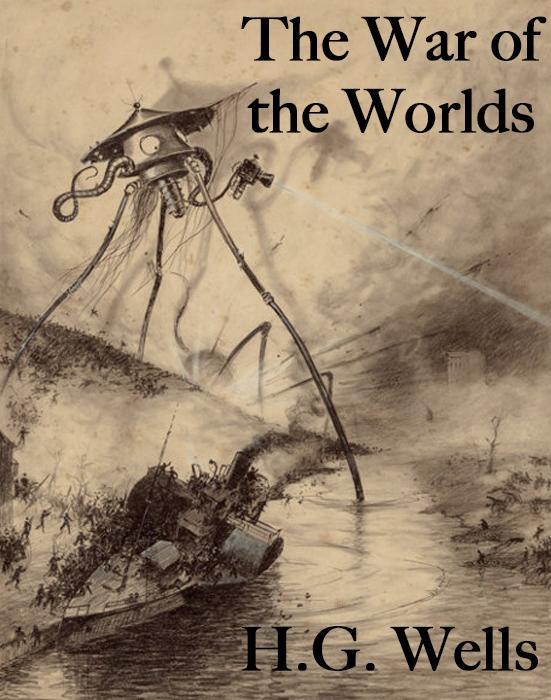
The Martians are depicted not as mere sluggish creatures but as highly intelligent, mechanical beings that have evolved into primarily brain-like entities devoid of organic digestion, feeding instead on the blood of other life forms. Their physiology is alien, featuring large, luminous eyes, tentacle-like appendages, and a body structure that seems almost fungus-like or fungoid, with a unique strategy of dispassionate slaughter using a heat-ray and lethal black smoke clouds. The narrative details the discovery of their cylinders, the scientific interpretations, and the initial misjudgments regarding their lethargic pace, which proves fatal when they swiftly unleash destructive alien weaponry.

The narrative vividly portrays the chaos as the Martians’ heat-ray scorches landscapes, burning towns like Weybridge and Shepperton, and their vapour-generated Black Smoke smothers the land, creating an atmosphere of universal panic. The protagonist, alongside other characters, witnesses the terrifying onslaught—machines towering than any human engineering, omnipresent destruction, and the helplessness of mankind’s military efforts. The account vividly describes the relentless advance of multiple Martian tripods, their formidable weaponry, and the devastation wrought on cities, communication, and transportation.

Despite seeming invincible and inhuman, the Martians are ultimately overcome through Earth's microscopic bacteria, with the story emphasizing nature’s unanticipated role in resisting invasion. The narrative concludes with an introspective reflection on the near-extermination of humanity, the fragile power of civilization, and the cosmic insignificance of mankind, pondering whether such invasions might recur—raising fears of future threats from Mars or other celestial bodies. The narrative’s tone is one of awe mixed with existential apprehension, contemplating humanity’s vulnerability in an infinite universe.

This detailed account exemplifies Wells’ mastery in blending scientific speculation, social comment, and cosmic perspective, leaving readers contemplating humanity’s precarious place amid a vast, indifferent cosmos.