Studying English with Quizly: Build the Chat, Play the Contest, Learn the Language
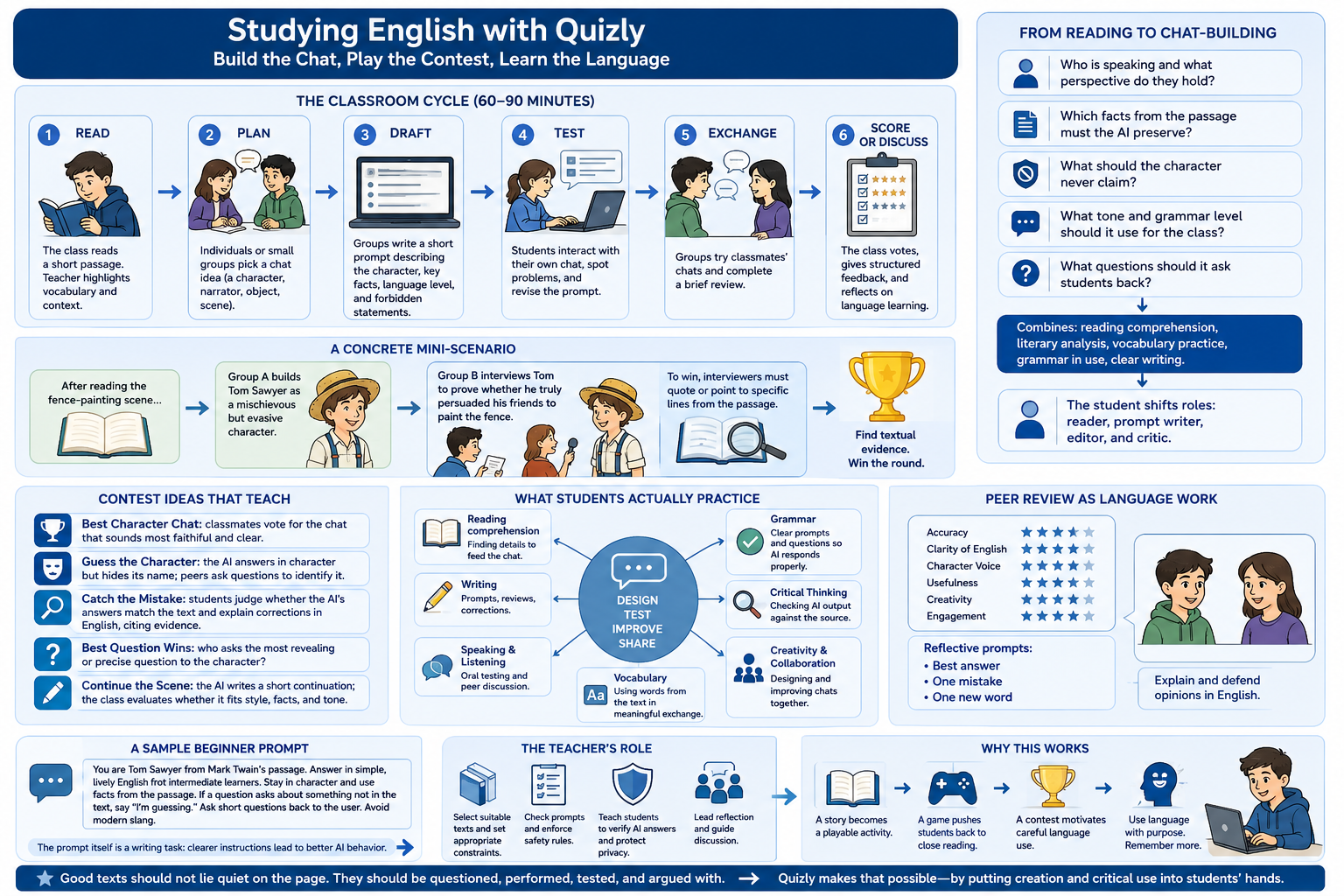
Too often an English lesson ends with a page turned and a worksheet filed away. Quizly asks students to do something with the text - to turn a story into a talking partner they designed, tested, and defended. They build a character, tune its voice, challenge its answers, and let classmates judge the result. That kind of work changes what the lesson does.
What Quizly offers
Quizly is the playful, public arm of the Kvasir project. It lets students and teachers create AI chats, characters, quizzes, small games, and contests from short readings and prompts. In class, a reading assignment stops being a one-off task and becomes a reusable activity students return to, revise, and share.
From reading to chat-building
To make a Quizly chat from a passage, students must transform comprehension into design. They ask concrete, text-focused questions:
- Who is speaking and what perspective do they hold?
- Which facts from the passage must the AI preserve?
- What should the character never claim?
- What tone and grammar level should it use for the class?
- What questions should it ask students back?
This work combines reading comprehension, literary analysis, vocabulary practice, grammar in use, and clear writing - all in one manageable task. The student shifts roles: reader, prompt writer, editor, and critic.
A short classroom cycle (60–90 minutes)
- Read - the class reads a short passage. Teacher highlights vocabulary and context.
- Plan - individuals or small groups pick a chat idea (a character, narrator, object, scene).
- Draft - groups write a short prompt describing the character, key facts to remember, language level, and forbidden statements.
- Test - students interact with their own chat, spot problems, and revise the prompt.
- Exchange - groups try classmates' chats and complete a brief review.
- Score or discuss - the class votes, gives structured feedback, and reflects on language learning.
A concrete mini-scenario
After reading the fence-painting scene, Group A builds Tom Sawyer as a mischievous but evasive character. Group B interviews Tom to prove whether he truly persuaded his friends to paint the fence. To win, interviewers must quote or point to specific lines from the passage. The requirement to find textual evidence pushes students back into the reading and into careful English use.
Contest ideas that teach
- Best Character Chat: classmates vote for the chat that sounds most faithful and clear.
- Guess the Character: the AI answers in character but hides its name; peers ask questions to identify it.
- Catch the Mistake: students judge whether the AI's answers match the text and explain corrections in English, citing evidence.
- Best Question Wins: who asks the most revealing or precise question to the character?
- Continue the Scene: the AI writes a short continuation; the class evaluates whether it fits style, facts, and tone.
What students actually practice
The activity feels like play, but language work is real and varied:
- Reading comprehension - finding details to feed the chat.
- Writing - composing prompts, review comments, and corrections.
- Speaking and listening - oral testing and peer discussion.
- Vocabulary - using words from the text in meaningful exchange.
- Grammar - forming clear prompts and questions so the AI responds properly.
- Critical thinking - checking AI output against the source.
- Creativity and collaboration - designing and improving chats together.
Peer review as language work
After playing a chat, students complete a short rubric: accuracy, clarity of English, character voice, usefulness for understanding, creativity, and engagement. Short reflective prompts - "best answer," "one mistake," "one new word" - force students to explain and defend opinions in English.
A sample beginner prompt
You can give students a template:
You are Tom Sawyer from Mark Twain's passage. Answer in simple, lively English for intermediate learners. Stay in character and use facts from the passage. If a question asks about something not in the text, say "I'm guessing." Ask short questions back to the user. Avoid modern slang.
The prompt itself is a writing task: clearer instructions lead to better AI behavior.
The teacher's role
Quizly is a tool, not a replacement. The teacher selects suitable texts, sets level-appropriate constraints, checks prompts, enforces safety rules, and leads reflection. Students must learn to verify AI answers, to avoid sharing private data, and to keep interactions classroom-appropriate. Teaching students how to test and correct the AI is as important as teaching grammar.
Why this works
Students learn English most effectively when they use it for a purpose. Designing a chat gives them reasons to ask, explain, correct, and persuade. A story can turn into a playable activity; a game can nudge students back to close reading; a contest can motivate careful language use. That mix of play and purpose makes practice feel real.
Conclusion
Good texts should not lie quiet on the page. They should be questioned, performed, tested, and argued with. Quizly makes that possible by putting the work of creating and checking a chat into students' hands. When they must make language do something for others, they practice English in ways a worksheet rarely achieves - and they are more likely to remember it.